


Why Where You Live (and What You Own) Affects What You Keep
When most investors evaluate an income-producing investment, they focus on the yield or distribution rate. But that number only tells part of the story. What an investor keeps after taxes can vary significantly depending on two things: how the income is characterized for tax purposes, and which state the investor lives in.
This is where the concept of tax-equivalent yield becomes useful.
.
What Is Tax-Equivalent Yield?
Tax-equivalent yield is a way of translating a tax-advantaged return into the yield an equivalent, fully-taxable investment would need to generate to leave an investor with the same after-tax income. It's a familiar concept in the municipal bond world, where investors have long compared tax-free muni yields to taxable alternatives. The same math applies to any investment that generates income taxed at a lower rate than ordinary income, or not taxed immediately at all.
.
Why the Type of Income Matters
Not all investment income is taxed the same way. Some distributions are taxed as ordinary income in the year they're received. Others may be classified differently, for example, as return of capital (ROC), which generally isn't taxed as income when received. Instead, it typically reduces the investor's cost basis, deferring the tax impact until the investment is sold. That deferral can meaningfully change the after-tax value of a distribution, especially for investors who plan to hold an investment for years.
This is a general tax concept, and how any specific distribution is characterized depends on the investment itself, so it's never safe to assume in advance how a given investment's income will be classified in a given year.
.
Why State Taxes Compound the Effect
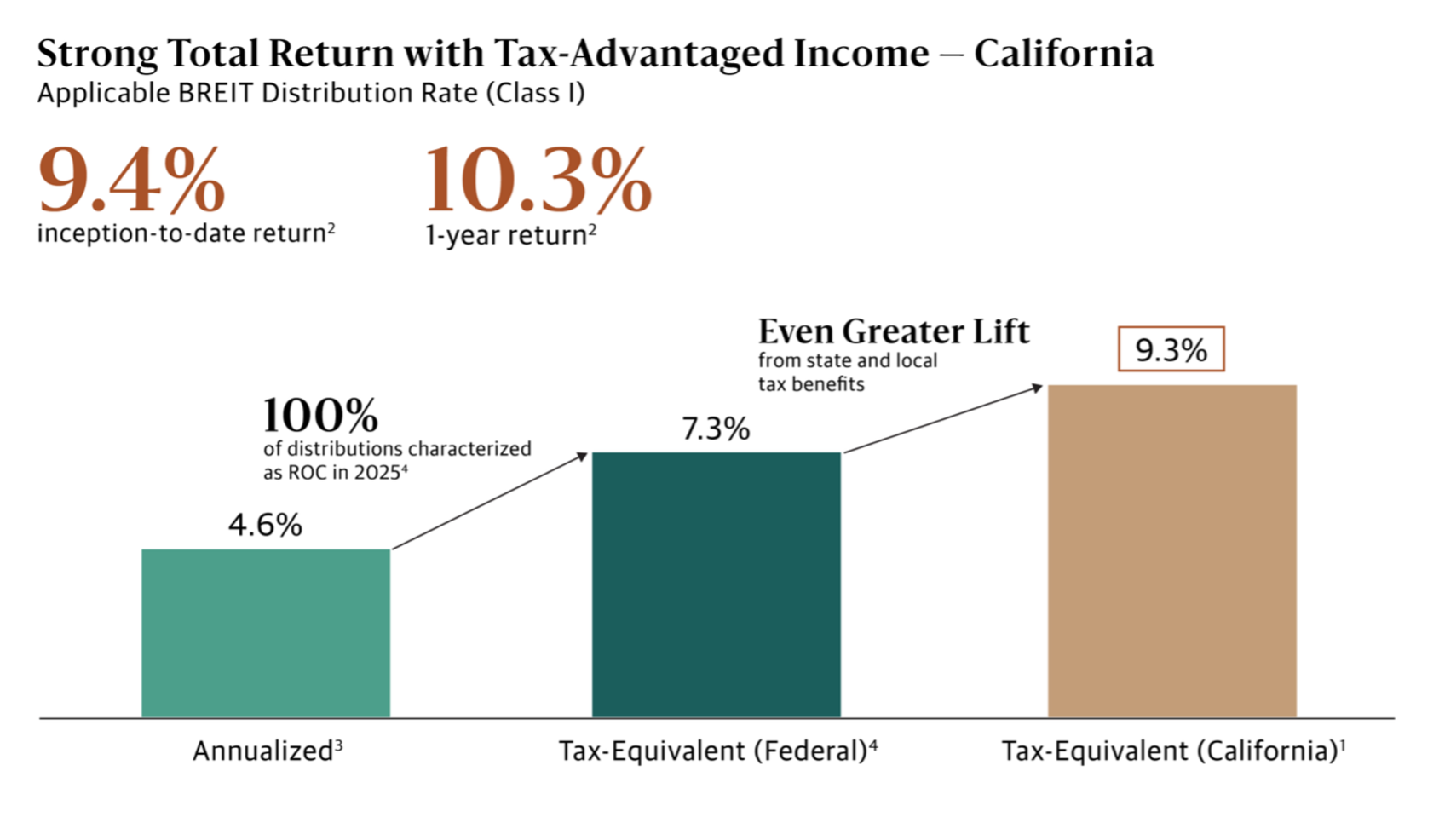
For investors in high-tax states, California among them, the effect can be even more pronounced. State income tax rates on ordinary investment income can add several percentage points to an investor's total tax burden. When a distribution is tax-deferred at both the federal and state level, the "tax-equivalent" yield needed from a fully-taxable alternative to match it can be substantially higher than the stated yield alone would suggest.
For example, this sample REIT chart shows how the investors’ tax rate could impact distributions an investment generates and what the client keeps after taxes.
SOURCE: Blackstone BREIT Tax Highlights
.
Why This Matters for Financial Planning
Understanding tax-equivalent yield isn't about chasing a specific product or number, it's about asking better questions when evaluating any income-generating investment:
- How is this distribution taxed, and is that likely to change year to year?
- What would an equivalent, fully-taxable investment need to yield to match this after-tax?
- How does my state's tax rate change that comparison?
These questions apply whether you're looking at municipal bonds, dividend-paying stocks, real estate income vehicles, or other income-oriented investments. The right answer depends entirely on an investor's individual tax situation, time horizon, liquidity needs, and risk tolerance — which is why this kind of analysis works best as part of a broader financial planning conversation, not a standalone decision.
.
Talk with us about your particular situation.
Contact Us
.
This material is for educational purposes only and does not constitute tax, legal, or investment advice. Tax treatment of any investment depends on individual circumstances and is subject to change. Please consult a qualified tax professional regarding your specific situation before making investment decisions. REITs are subject to various risks such as illiquidity and property devaluations based on adverse economic and real estate market conditions and may not be suitable for all investors. A prospectus that discloses all risks, fees and expenses may be obtained from 424-363-6862. Read the prospectus carefully before investing. This is not a solicitation or offering which can only be made in conjunction with a copy of the prospectus.